Let's talk data archiving: practical insights into FAIR and long-term data management from early-career perspectives

Joana Kristin Steffens
CORRESPONDING AUTHOR
German National Committee of the Association of Polar Early Career Scientists (APECS Germany), Germany
Institut des Sciences de la Mer de Rimouski (ISMER), Université du Québec à Rimouski (UQAR), Rimouski, QC G5L 2Z9, Canada
Lukas Monrad-Krohn
German National Committee of the Association of Polar Early Career Scientists (APECS Germany), Germany
Department of Geosciences, University of Oslo, 0316 Oslo, Norway
Amelie Driemel
Alfred-Wegener-Institut Helmholtz-Zentrum für Polar- und Meeresforschung, 27570 Bremerhaven, Germany
Nicole Greco
National Center for Ecological Analysis and Synthesis, University of California, Santa Barbara, 93101, United States of America
Johannes Röttenbacher
Institute of Environmental Physics, University of Bremen, 28359 Bremen, Germany
Related authors
No articles found.
Liss Marie Andreassen, Ketil Isaksen, Lukas J. Monrad-Krohn, Jogscha M. Abderhalden, Luc Girod, Jessica De Marco, Bernd Etzelmüller, Simon Oldani, and Rune Strand Ødegård
EGUsphere, https://doi.org/10.5194/egusphere-2026-3152, https://doi.org/10.5194/egusphere-2026-3152, 2026
Short summary
Short summary
Juvfonne is a small ice patch and contains the oldest ice dated in Norway so far. Juvfonne prevails due to drifting snow and can fill up after years with surface lowering. However, the reduction in area and volume over the period 2010–2025 reveal that Juvfonne is vulnerable to the current warming. Ice thickness measurements conducted in September 2025 reveal a current maximum thickness of less than 9 meters and an interpolated mean thickness of < 3 meters.
Steven Franke, Daniel Steinhage, Veit Helm, Tobias Binder, Uwe Nixdorf, Heinrich Miller, Angelika Humbert, Daniela Jansen, Graeme Eagles, Hannes Eisermann, Wilfried Jokat, Antonia Ruppel, Reinhard Drews, Alexandra Zuhr, Amelie Driemel, Andreas Walter, Peter Konopatzky, Robin Heß, Antonie Haas, Roland Koppe, Pascal H. Andreas, and Olaf Eisen
The Cryosphere, 20, 2485–2530, https://doi.org/10.5194/tc-20-2485-2026, https://doi.org/10.5194/tc-20-2485-2026, 2026
Short summary
Short summary
This review synthesizes 30 years of Alfred Wegener Institute’s (AWI) airborne radar research in Antarctica and Greenland, detailing six radar systems and their applications in studying ice dynamics, basal properties, and subglacial landscapes. Moreover, it introduces the public release of AWI's airborne radar datasets via the Radar Data over Polar Ice Sheets Viewer and PANGAEA, ensuring findable, accessible, interoperable, and reusable access for future polar research.
André Ehrlich, Susanne Crewell, Andreas Herber, Marcus Klingebiel, Christof Lüpkes, Mario Mech, Sebastian Becker, Stephan Borrmann, Heiko Bozem, Matthias Buschmann, Hans-Christian Clemen, Elena De La Torre Castro, Henning Dorff, Regis Dupuy, Oliver Eppers, Florian Ewald, Geet George, Andreas Giez, Sarah Grawe, Christophe Gourbeyre, Jörg Hartmann, Evelyn Jäkel, Philipp Joppe, Olivier Jourdan, Zsófia Jurányi, Benjamin Kirbus, Johannes Lucke, Anna E. Luebke, Maximilian Maahn, Nina Maherndl, Christian Mallaun, Johanna Mayer, Stephan Mertes, Guillaume Mioche, Manuel Moser, Hanno Müller, Veronika Pörtge, Nils Risse, Greg Roberts, Sophie Rosenburg, Johannes Röttenbacher, Michael Schäfer, Jonas Schaefer, Andreas Schäfler, Imke Schirmacher, Johannes Schneider, Sabrina Schnitt, Frank Stratmann, Christian Tatzelt, Christiane Voigt, Andreas Walbröl, Anna Weber, Bruno Wetzel, Martin Wirth, and Manfred Wendisch
Earth Syst. Sci. Data, 17, 1295–1328, https://doi.org/10.5194/essd-17-1295-2025, https://doi.org/10.5194/essd-17-1295-2025, 2025
Short summary
Short summary
This paper provides an overview of the HALO–(AC)3 aircraft campaign data sets, the campaign-specific instrument operation, data processing, and data quality. The data set comprises in situ and remote sensing observations from three research aircraft: HALO, Polar 5, and Polar 6. All data are published in the PANGAEA database by instrument-separated data subsets. It is highlighted how the scientific analysis of the HALO–(AC)3 data benefits from the coordinated operation of three aircraft.
Manfred Wendisch, Susanne Crewell, André Ehrlich, Andreas Herber, Benjamin Kirbus, Christof Lüpkes, Mario Mech, Steven J. Abel, Elisa F. Akansu, Felix Ament, Clémantyne Aubry, Sebastian Becker, Stephan Borrmann, Heiko Bozem, Marlen Brückner, Hans-Christian Clemen, Sandro Dahlke, Georgios Dekoutsidis, Julien Delanoë, Elena De La Torre Castro, Henning Dorff, Regis Dupuy, Oliver Eppers, Florian Ewald, Geet George, Irina V. Gorodetskaya, Sarah Grawe, Silke Groß, Jörg Hartmann, Silvia Henning, Lutz Hirsch, Evelyn Jäkel, Philipp Joppe, Olivier Jourdan, Zsofia Jurányi, Michail Karalis, Mona Kellermann, Marcus Klingebiel, Michael Lonardi, Johannes Lucke, Anna E. Luebke, Maximilian Maahn, Nina Maherndl, Marion Maturilli, Bernhard Mayer, Johanna Mayer, Stephan Mertes, Janosch Michaelis, Michel Michalkov, Guillaume Mioche, Manuel Moser, Hanno Müller, Roel Neggers, Davide Ori, Daria Paul, Fiona M. Paulus, Christian Pilz, Felix Pithan, Mira Pöhlker, Veronika Pörtge, Maximilian Ringel, Nils Risse, Gregory C. Roberts, Sophie Rosenburg, Johannes Röttenbacher, Janna Rückert, Michael Schäfer, Jonas Schaefer, Vera Schemann, Imke Schirmacher, Jörg Schmidt, Sebastian Schmidt, Johannes Schneider, Sabrina Schnitt, Anja Schwarz, Holger Siebert, Harald Sodemann, Tim Sperzel, Gunnar Spreen, Bjorn Stevens, Frank Stratmann, Gunilla Svensson, Christian Tatzelt, Thomas Tuch, Timo Vihma, Christiane Voigt, Lea Volkmer, Andreas Walbröl, Anna Weber, Birgit Wehner, Bruno Wetzel, Martin Wirth, and Tobias Zinner
Atmos. Chem. Phys., 24, 8865–8892, https://doi.org/10.5194/acp-24-8865-2024, https://doi.org/10.5194/acp-24-8865-2024, 2024
Short summary
Short summary
The Arctic is warming faster than the rest of the globe. Warm-air intrusions (WAIs) into the Arctic may play an important role in explaining this phenomenon. Cold-air outbreaks (CAOs) out of the Arctic may link the Arctic climate changes to mid-latitude weather. In our article, we describe how to observe air mass transformations during CAOs and WAIs using three research aircraft instrumented with state-of-the-art remote-sensing and in situ measurement devices.
Johannes Röttenbacher, André Ehrlich, Hanno Müller, Florian Ewald, Anna E. Luebke, Benjamin Kirbus, Robin J. Hogan, and Manfred Wendisch
Atmos. Chem. Phys., 24, 8085–8104, https://doi.org/10.5194/acp-24-8085-2024, https://doi.org/10.5194/acp-24-8085-2024, 2024
Short summary
Short summary
Weather prediction models simplify the physical processes related to light scattering by clouds consisting of complex ice crystals. Whether these simplifications are the cause for uncertainties in their prediction can be evaluated by comparing them with measurement data. Here we do this for Arctic ice clouds over sea ice using airborne measurements from two case studies. The model performs well for thick ice clouds but not so well for thin ones. This work can be used to improve the model.
Andreas Walbröl, Janosch Michaelis, Sebastian Becker, Henning Dorff, Kerstin Ebell, Irina Gorodetskaya, Bernd Heinold, Benjamin Kirbus, Melanie Lauer, Nina Maherndl, Marion Maturilli, Johanna Mayer, Hanno Müller, Roel A. J. Neggers, Fiona M. Paulus, Johannes Röttenbacher, Janna E. Rückert, Imke Schirmacher, Nils Slättberg, André Ehrlich, Manfred Wendisch, and Susanne Crewell
Atmos. Chem. Phys., 24, 8007–8029, https://doi.org/10.5194/acp-24-8007-2024, https://doi.org/10.5194/acp-24-8007-2024, 2024
Short summary
Short summary
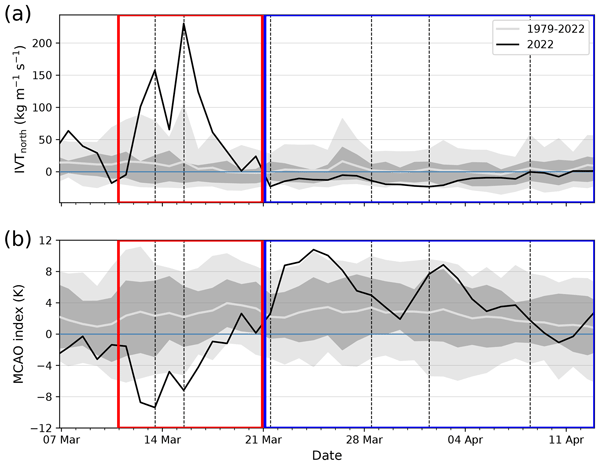
To support the interpretation of the data collected during the HALO-(AC)3 campaign, which took place in the North Atlantic sector of the Arctic from 7 March to 12 April 2022, we analyze how unusual the weather and sea ice conditions were with respect to the long-term climatology. From observations and ERA5 reanalysis, we found record-breaking warm air intrusions and a large variety of marine cold air outbreaks. Sea ice concentration was mostly within the climatological interquartile range.
Hanno Müller, André Ehrlich, Evelyn Jäkel, Johannes Röttenbacher, Benjamin Kirbus, Michael Schäfer, Robin J. Hogan, and Manfred Wendisch
Atmos. Chem. Phys., 24, 4157–4175, https://doi.org/10.5194/acp-24-4157-2024, https://doi.org/10.5194/acp-24-4157-2024, 2024
Short summary
Short summary
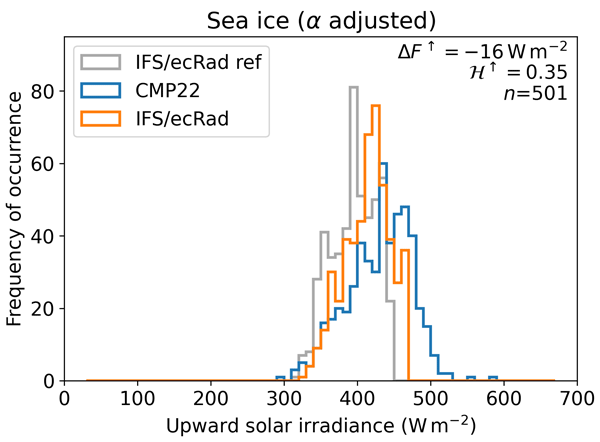
A weather model is used to compare solar radiation with measurements from an aircraft campaign in the Arctic. Model and observations agree on the downward radiation but show differences in the radiation reflected by the surface and the clouds, which in the model is too low above sea ice and too high above open ocean. The model–observation bias is reduced above open ocean by a realistic fraction of clouds and less cloud liquid water and above sea ice by less dark sea ice and more cloud droplets.
Sabrina Schnitt, Andreas Foth, Heike Kalesse-Los, Mario Mech, Claudia Acquistapace, Friedhelm Jansen, Ulrich Löhnert, Bernhard Pospichal, Johannes Röttenbacher, Susanne Crewell, and Bjorn Stevens
Earth Syst. Sci. Data, 16, 681–700, https://doi.org/10.5194/essd-16-681-2024, https://doi.org/10.5194/essd-16-681-2024, 2024
Short summary
Short summary
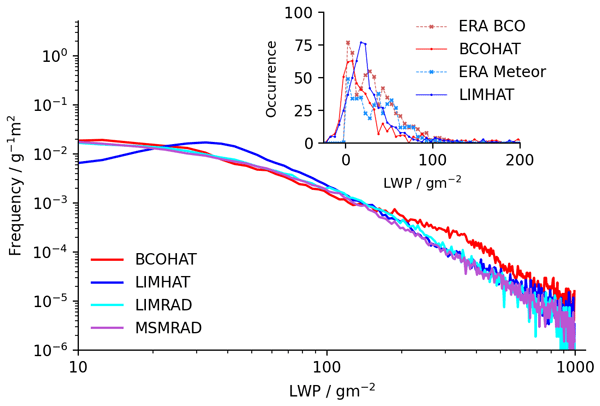
This publication describes the microwave radiometric measurements performed during the EUREC4A campaign at Barbados Cloud Observatory (BCO) and aboard RV Meteor and RV Maria S Merian. We present retrieved integrated water vapor (IWV), liquid water path (LWP), and temperature and humidity profiles as a unified, quality-controlled, multi-site data set on a 3 s temporal resolution for a core period between 19 January 2020 and 14 February 2020.
Angelika Graiff, Matthias Braun, Amelie Driemel, Jörg Ebbing, Hans-Peter Grossart, Tilmann Harder, Joseph I. Hoffman, Boris Koch, Florian Leese, Judith Piontek, Mirko Scheinert, Petra Quillfeldt, Jonas Zimmermann, and Ulf Karsten
Polarforschung, 91, 45–57, https://doi.org/10.5194/polf-91-45-2023, https://doi.org/10.5194/polf-91-45-2023, 2023
Short summary
Short summary
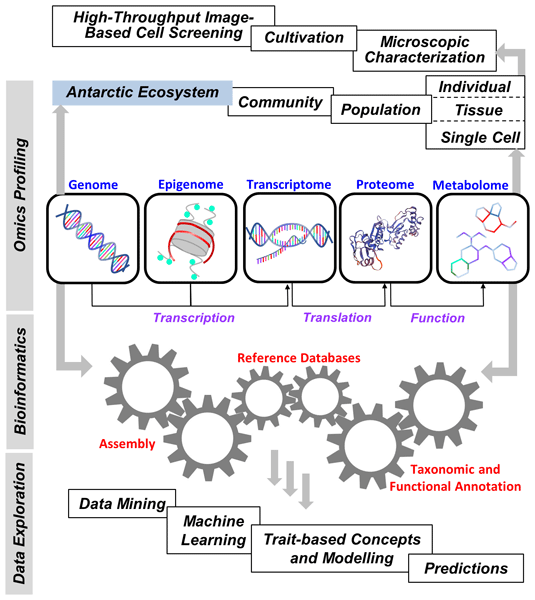
There are many approaches to better understanding Antarctic processes that generate very large data sets (
Antarctic big data). For these large data sets there is a pressing need for improved data acquisition, curation, integration, service, and application to support fundamental scientific research, and this article describes and evaluates the current status of big data in various Antarctic scientific disciplines, identifies current gaps, and provides solutions to fill these gaps.
Heike Kalesse-Los, Anton Kötsche, Andreas Foth, Johannes Röttenbacher, Teresa Vogl, and Jonas Witthuhn
Atmos. Meas. Tech., 16, 1683–1704, https://doi.org/10.5194/amt-16-1683-2023, https://doi.org/10.5194/amt-16-1683-2023, 2023
Short summary
Short summary
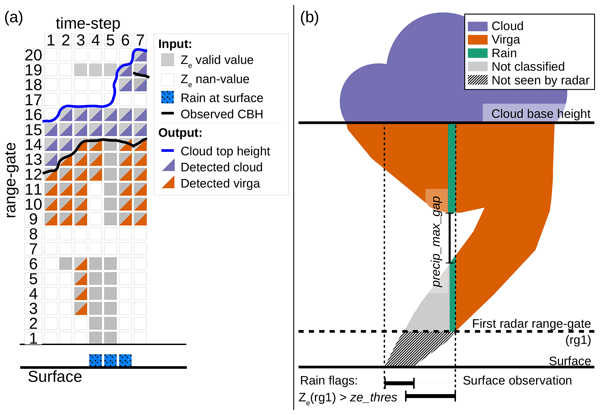
The Virga-Sniffer, a new modular open-source Python package tool to characterize full precipitation evaporation (so-called virga) from ceilometer cloud base height and vertically pointing cloud radar reflectivity time–height fields, is described. Results of its first application to RV Meteor observations during the EUREC4A field experiment in January–February 2020 are shown. About half of all detected clouds with bases below the trade inversion height were found to produce virga.
Cited articles
Colavizza, G., Cadwallader, L., LaFlamme, M., Dozot, G., Lecorney, S., Rappo, D., and Hrynaszkiewicz, I.: An analysis of the effects of sharing research data, code, and preprints on citations, PLOS ONE, 19, e0311493, https://doi.org/10.1371/journal.pone.0311493, 2024.
Eaton, B., Gregory, J., Drach, B., Taylor, K., Hankin, S., Blower, J., Caron, J., Signell, R., Bentley, P., Rappa, G., Höck, H., Pamment, A., Juckes, M., Raspaud, M., and Horne, R.: NetCDF Climate and Forecast (CF) Metadata Conventions, http://cfconventions.org/ (last access: 12 October 2026), 2017.
Felden, J., Möller, L., Schindler, U., Huber, R., Schumacher, S., Koppe, R., Diepenbroek, M., and Glöckner, F. O.: PANGAEA – Data Publisher for Earth & Environmental Science, Sci. Data, 10, 347, https://doi.org/10.1038/s41597-023-02269-x, 2023.
Genderjahn, S. and Schrader, A.: Persistente Identifikatoren als Fundament unserer Wissenslandschaft: Die PID-Roadmap für Deutschland, 114. BiblioCON, Berlin, Zenodo [data set], https://doi.org/10.5281/zenodo.20426735, 2026.
Khider, D., Emile-Geay, J., McKay, N. P., Gil, Y., Garijo, D., Ratnakar, V., Alonso-Garcia, M., Bertrand, S., Bothe, O., Brewer, P., Bunn, A., Chevalier, M., Comas-Bru, L., Csank, A., Dassié, E., DeLong, K., Felis, T., Francus, P., Frappier, A., Gray, W., Goring, S., Jonkers, L., Kahle, M., Kaufman, D., Kehrwald, N. M., Martrat, B., McGregor, H., Richey, J., Schmittner, A., Scroxton, N., Sutherland, E., Thirumalai, K., Allen, K., Arnaud, F., Axford, Y., Barrows, T., Bazin, L., Pilaar Birch, S. E., Bradley, E., Bregy, J., Capron, E., Cartapanis, O., Chiang, H.-W., Cobb, K. M., Debret, M., Dommain, R., Du, J., Dyez, K., Emerick, S., Erb, M. P., Falster, G., Finsinger, W., Fortier, D., Gauthier, N., George, S., Grimm, E., Hertzberg, J., Hibbert, F., Hillman, A., Hobbs, W., Huber, M., Hughes, A. L. C., Jaccard, S., Ruan, J., Kienast, M., Konecky, B., Le Roux, G., Lyubchich, V., Novello, V. F., Olaka, L., Partin, J. W., Pearce, C., Phipps, S. J., Pignol, C., Piotrowska, N., Poli, M.-S., Prokopenko, A., Schwanck, F., Stepanek, C., Swann, G. E. A., Telford, R., Thomas, E., Thomas, Z., Truebe, S., von Gunten, L., Waite, A., Weitzel, N., Wilhelm, B., Williams, J., Williams, J. J., Winstrup, M., Zhao, N., and Zhou, Y.: PaCTS 1.0: A crowdsourced reporting standard for paleoclimate data, Paleoceanogr. Paleoclimatol., 34, 1570–1596, https://doi.org/10.1029/2019PA003632, 2019.
Piwowar, H. A., Vision, T. J., and Whitlock, M. C.: Data archiving is a good investment, Nature, 473, 285, https://doi.org/10.1038/473285a, 2011.
Wilkinson, M., Dumontier, M., Aalbersberg, I. J., Appleton, G., Axton, M., Baak, A., Blomberg, N., Boiten, J.-W., Bonino da Silva Santos, L., Bourne, P. E., Bouwman, J., Brookes, A. J., Clark, T., Crosas, M., Dillo, I., Dumon, O., Edmunds, S., Evelo, C. T., Finkers, R., Gonzalez-Beltran, A., Gray, A. J. G., Groth, P., Goble, C., Grethe, J. S., Heringa, J., 't Hoen, P. A. C., Hooft, R., Kuhn, T., Kok, R., Kok, J., Lusher, S. J., Martone, M. E., Mons, A., Packer, A. L., Persson, B., Rocca-Serra, P., Roos, M., van Schaik, R., Sansone, S.-A., Schultes, E., Sengstag, T., Slater, T., Strawn, G., Swertz, M. A., Thompson, M., van der Lei, J., van Mulligen, E., Velterop, J., Waagmeester, A., Wittenburg, P., Wolstencroft, K., Zhao, J., and Mons, B.: The FAIR Guiding Principles for scientific data management and stewardship, Sci. Data, 3, 160018, https://doi.org/10.1038/sdata.2016.18, 2016.
Short summary
Research data only retain their value when they are properly documented and preserved. This report summarizes insights from a seminar on data archiving for early-career researchers. Contributions from data repositories and research projects showed that early planning, clear metadata, and shared responsibility improve data reuse, reproducibility, and scientific impact. Continued training and community standards will further strengthen research quality.
Research data only retain their value when they are properly documented and preserved. This...