
 | 16 Mar 2026
12th International Conference on Permafrost in Whitehorse, Canada: early career researchers' insights and contributions
Pia Petzold
Melanie Stammler
The 12th International Conference on Permafrost (ICOP) was held in Whitehorse, Canada, from 16 to 20 June 2024, with the overall theme “Integrating perspectives of permafrost thaw, change, and adaptation”. The conference brought together numerous different permafrost-related research disciplines, allowing for inter- and intra-disciplinary exchange and collaboration. Over 470 permafrost researchers from all over the world gathered in Whitehorse to attend the conference and share their findings, in a place where permafrost is also highly relevant to the local community, environment, and infrastructure. The conference venue was a great place to exchange ideas and a great place for graduate students and early career scientists who want to be actively involved in the permafrost community. Funding from the German Society for Polar Research (DGP) enabled three early career scientists from Germany to attend the conference and benefit from this unique opportunity to gain knowledge, skills, and inspiration, and to expand their network in the scientific community. We would like to emphasize that such funding is extremely valuable for fostering the integration of early career researchers (ECRs) into the global research community.
- Article
(2749 KB) - Full-text XML
- BibTeX
- EndNote


The 12th International Conference on Permafrost (ICOP), organized by the International Permafrost Association (IPA) in collaboration with the Canadian Permafrost Association, the Canadian Geotechnical Society and the Permafrost Young Researchers Network, took place in Whitehorse, Canada, from 16 to 20 June 2024. The overarching theme of this year's ICOP, “Integrating Perspectives of Permafrost Thaw, Change, and Adaptation”, timely underscores the urgency for a comprehensive understanding of climate change impacts on permafrost and the need to develop adaptation strategies based on sound science.
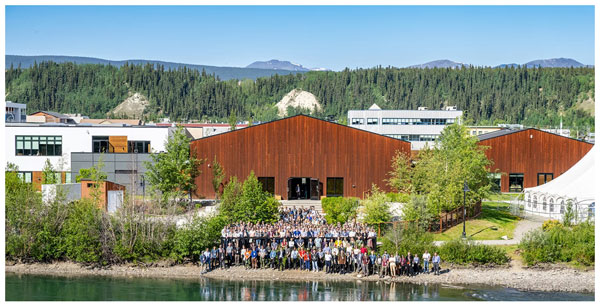
Since the first ICOP was held in 1963, it has been hosted by the US, China, Russia, Switzerland, Norway, Germany, and Canada, and it has consistently attracted great international interest. Between 400 and 1000 participants from 35 nations have attended previous conferences, confirming that ICOP is a nexus for the global permafrost community. This year's conference received great attention from the scientific community: the conference program comprised an impressive number of 227 oral presentations as well as 199 in-person and 67 virtual posters. With the great hospitality of the local Indigenous communities, the Kwanlin Dün and the Ta'an Kwäch'än, the conference was held in the newly built Kwanlin Dün Cultural Center.
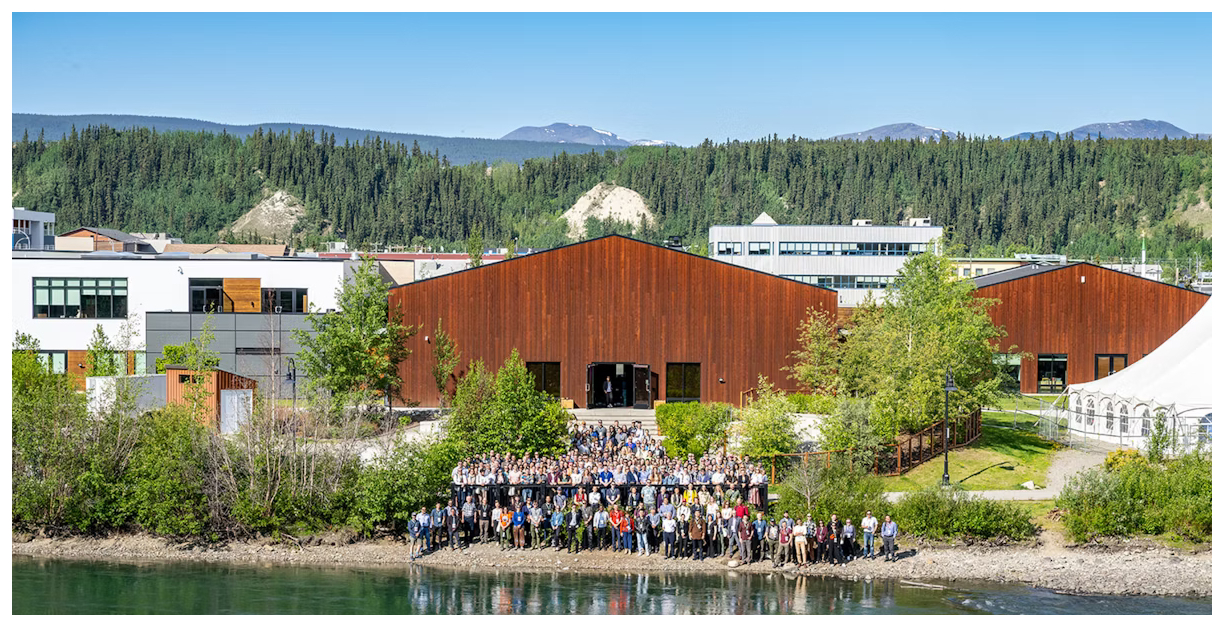
Figure 1Group picture from on-site participants of the 12th ICOP in front of the Kwanlin Dün Cultural Centre. Source: ICOP organizing committee, June 2024.
Before the official start of the 12th International Conference on Permafrost, around 100 early career researchers (ECRs) had the opportunity to connect with each other in a workshop organized by the Permafrost Young Researchers Network (PYRN) on 16 June. The day started early and was filled with keynotes and discussions on various permafrost-related topics, focusing on questions and issues relevant to ECRs. Élise Devoie (Queens University) introduced the audience to her research at the Scotty Creek Research Station (Canada's first Indigenous-led research park) and showed what she had learned co-creating her research with community partners. Brett Young (Hudson Bay Railway) gave a presentation “Finding balance; opportunities and challenges of young professionals, the Arctic, and railways over permafrost”, presenting a more technical perspective on permafrost thaw before Victor Leshyk (Center for Ecosystem Science and Society (Ecoss) at Northern Arizona University) motivated the ECRs to be more creative and courageous when it comes to scientific graphics. Regula Frauenfelder (Norwegian Geotechnical Institute) reminded the audience in her talk “Perspectives on Career Paths in Geosciences” that careers in research can look very different and often do not follow a straight path. Michael Krautblatter (Technical University of Munich) drew attention to the their topic, “Struggles and advantages of working in Arctic and Alpine permafrost early in your career”, and added some helpful advice on how to improve one's resilience. Finally, with her talk “Navigating Scientific Pathways: An early career perspective”, McKenzie Kuhn (University of British Columbia) inspired the audience to find their own way in the research community by taking one step at a time and being open to new (unplanned) adventures along the way. The whole workshop as well as the keynote speeches were well organized and provided many opportunities to discuss possible career paths and to start to build a network between all the ECRs present.
The 12th ICOP began with an icebreaker event at the MacBride Museum on the evening of 16 June. All conference participants had the opportunity to (re-)connect with colleagues and friends in the research community, surrounded by an interesting exhibition on the history of the Yukon.
Each day of the conference started with a keynote presentation, covering current research topics on permafrost as well as personal insights into how permafrost research can interact with and be improved by local knowledge. In the first keynote speech, Pascale Roy-Léveillée spoke on “Permafrost Dynamics and Landscape Evolution in the Thermokarst Plain of the Old Crow Flats”, providing not only an insight into the research she has conducted in the area over the past 15 years but also a personal insight into the connections that have been made and the shared hope for resilience (Roy-Leveillee, 2015).
The keynote speeches were then followed by up to five concurrent sessions, covering topics such as infrastructure, carbon cycles, remote sensing, monitoring, biogeochemistry, and social sciences. There were 72 full papers and 450 extended abstracts submitted and published by the International Permafrost Association (Beddoe and Karunaratne, 2024). With four presentation blocks per day, the conference was filled with different perspectives on permafrost. In the evenings, the poster sessions took place in the garden of the Kwanlin Dün Cultural Center along the Chu Nínkwän (Yukon River) waterfront, where the discussions of the day were continued and deepened by looking at the insightful posters. The German Society for Polar Research (DGP) supported Verena Bischoff, Pia Petzold, and Melanie Stammler in attending the conference (Fig. 2). With additional funding from the Permafrost Young Researchers Network (PYRN), Verena Bischoff had the opportunity to present her research “Greenhouse gas production potential of drained lake basin sediments from the Yukon Coastal Plain” in session 6B. Her laboratory incubation studies revealed immediate methane production in the often-still-waterlogged drained lake basin sediments and demonstrated the overall high lability of carbon to microbial degradation upon thaw in these vastly changing environments.
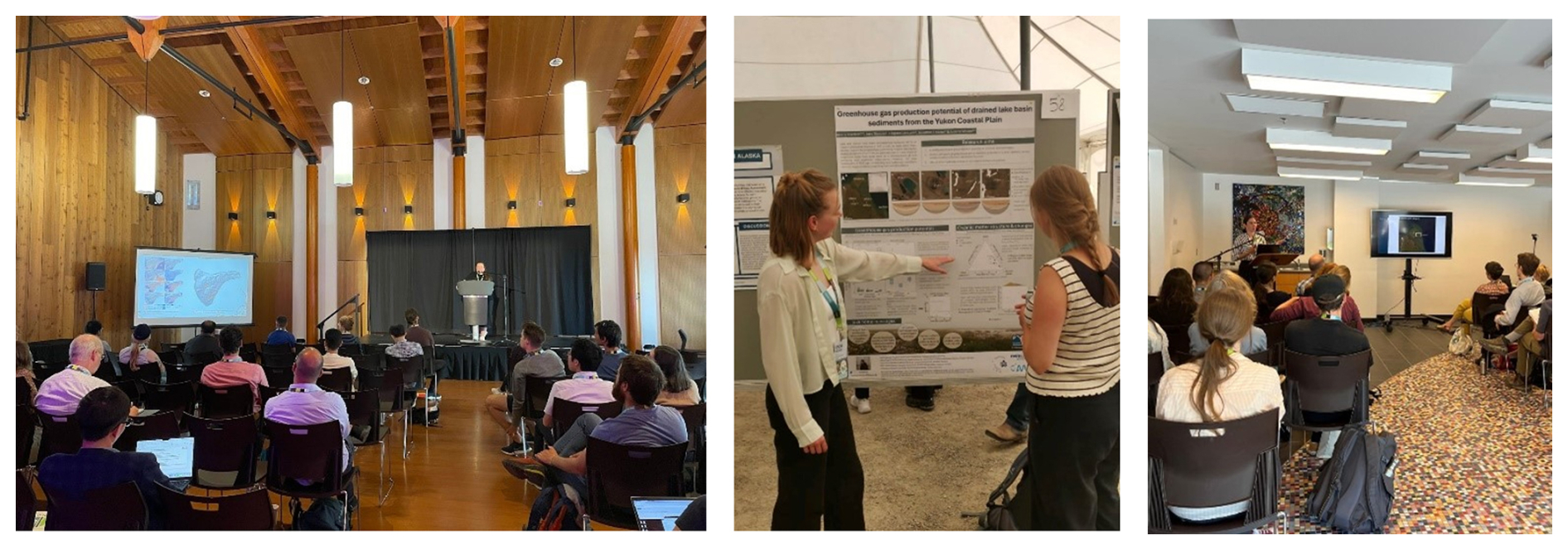
Figure 2Grant recipients at the 12th ICOP in Whitehorse, Canada. Left: Melanie Stammler giving her presentation; center: Verena Bischoff presenting her poster; right: Pia Petzold presenting her master's thesis project. Pictures taken by grant recipients, Whitehorse, June 2024.
Pia Petzold presented her master's thesis project “Organic Carbon Composition and Transport linked to Wind Forcing in the Nearshore Zone of Herschel Island, Qikiqtaruk (NW-Canada)” in session 3F-Polar Coastlines in Transition: Arctic, Antarctic, offshore and shelf. The data she collected and analyzed during her project underpin how sensitive the Arctic nearshore zone can be to external factors such as wind. These factors can have a direct impact on the role of the nearshore zone as a carbon source or sink. Pia's presentation was followed by a lively discussion with numerous helpful remarks on how she could continue her research in the future. Her on-site presentation would have not been possible without the financial support from the DGP, the University of Potsdam, and the ILLUQ project.
Melanie Stammler gave an oral presentation titled “Vertical surface change signals of rock glaciers: combining UAV and Pléiades imagery (Agua Negra, Argentina)” in session 10A – Remote Sensing of Permafrost Processes and Impacts on the Environment. She compared three processing strategies for the generation of digital elevation models based on remotely sensed data and highlighted the need for understanding the impact of the choice of software when investigating vertical surface changes on rock glaciers using UAV and Pléiades data. The content of her presentation was published as a full conference paper; see Stammler et al. (2024). Her on-site attendance at the 12th ICOP in Whitehorse would have not been possible without the financial support by PYRN and the IAG, the University of Bonn, the DGGM and the DGP.
Due to the unique setting of the ICOP 2024 in Whitehorse, located in the sporadic discontinuous permafrost zone, attendees had the opportunity to learn about the impact of permafrost on the lives of residents first-hand (Fig. 3). During the mid-conference field trips, different perspectives on local permafrost could be experienced with excursions to the Ibex Valley, a local wildlife preserve, and historic mining sites, on an orientation hike, and during a workshop on truth and reconciliation as part of Indigenous-engaged community-based research.
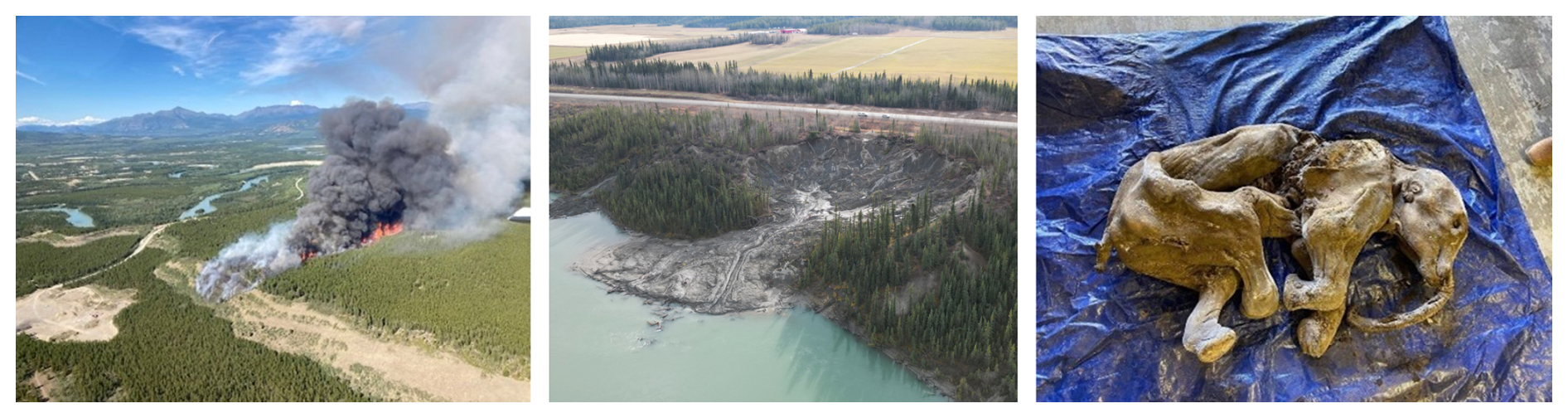
Figure 3Local relevance of permafrost in the Whitehorse area. Left: wildfire threatening infrastructure in the Ibex valley (WhiteHorse Daily Star, 2026); center: Takhini River retrogressive thaw slump adjacent to the Alaska Highway at km 1456 (ICOP, 2024a); right: Nun Cho Ga, the mummified baby wooly mammoth discovered in the Klondike region in 2022 (ICOP, 2024b).
A group of conference participants had the chance to visit the Ibex Valley, where vegetation is only slowly recovering from a disastrous wildfire in 1958. Research carried out in the following decades revealed a significantly lowered but stabilized permafrost table, demonstrating the persistence of ice-rich permafrost (Burn, 1998). However, a subsequent 7-year field experiment led by Chris Burn from 1997 to 2003 showed that even under modified conditions at a test site, permafrost did not re-aggregate in the affected areas. These results suggest that the permafrost conditions were irreversibly altered by this event. This highlights that most of today's permafrost is relict and cannot recover under current climate conditions, which is important in light of the increasing number of wildfires in the Canadian Arctic. Chris Burn, Chancellor's Professor of Geography and Environmental Studies at Carleton University and outgoing President of the International Permafrost Association (IPA), reiterated the importance of this study to a wider audience in the conference's final keynote speech.
In the Ibex Valley, it also becomes apparent how thawing permafrost can endanger infrastructure. Recently, the Alaska Highway had to be rerouted due to the threat of a retrogressive thaw slump forming on the banks of the Takhini River near the important road (Calmels et al., 2021; Povoroznyuk et al., 2023). The site demonstrated the significant need for frequent monitoring which requires both research focus and financial effort. The geotechnical perspective on permafrost thaw, and its potential to alter the Yukon landscape, was provided by Jocelyn L. Hayley, Professor in the Department of Civil Engineering at the University of Calgary.
The confluence of scientific and cultural aspects of permafrost was highlighted in the keynote speech by Jeffrey Bond (Yukon Geological Survey), Debbie Nagano (Director of Heritage, Tr'ondëk Hwëch'in Government), and Grant Zazula (Yukon Government Palaeontology Program). They discussed the palaeoecological and spiritual significance of the discovery of Nun Cho Ga, a 36 000-year-old mummified woolly mammoth found well-preserved in Yukon permafrost in the summer of 2022. The research was carried out in consultation with representatives of the Tr'ondëk Hwëch'in First Nation, who hold a guardianship role of the animal and ensured its spiritual preservation.
A limited number of attendees further had the opportunity to learn about Yukon First Nation culture and history from Amber Berard-Althouse, a member of the Kluane First Nation, during daily interpretive walks along the Yukon River.
The field trips and talks contributed to an understanding of the local community's past and present relationship with permafrost, as well as the importance of adaptation strategies to the challenges posed by permafrost thaw.
A smaller group of participants had the opportunity to take part in a post-conference field trip led to Inuvik and the surrounding area. This included a day trip to the Northwest Territories provincial border, a day trip to Tuktoyaktuk, a helicopter flight over various periglacial landforms and the Mackenzie River delta, and a boat trip through the delta. The excursion allowed all the participants to see and discuss thaw slumps, patterned ground, coastal erosion, and permafrost-adapted infrastructure planning up close.
For all of us, ICOP 2024 was the largest international conference we were able to attend and therefore a unique opportunity to present our research to the international permafrost research community. Moreover, we also gained valuable knowledge and insights into new (for us) permafrost-related research areas, which will improve our research projects in the coming years. New personal connections were made and already existing ones were deepened. Throughout the conference and in each research area, the importance of integrating local knowledge and perspectives on permafrost with the natural sciences was emphasized. By attending this conference, we, a group of young natural scientists, gained new perspectives on the heritage of our study sites and how we can actively contribute to it in the future.
This study did not generate or analyse any datasets.
VB, PP, MS: Writing – original draft preparation, Writing – review and editing, Funding acquisition.
The contact author has declared that none of the authors has any competing interests.
Publisher’s note: Copernicus Publications remains neutral with regard to jurisdictional claims made in the text, published maps, institutional affiliations, or any other geographical representation in this paper. While Copernicus Publications makes every effort to include appropriate place names, the final responsibility lies with the authors.
First and foremost we would like to thank the Kwanlin Dün and Ta'an Kwäch'än First Nations and the City of Whitehorse for hosting us at the Kwanlin Dün Cultural Centre for this conference. We would also like to extend our appreciation to the local organizing committee and the Yukon University for their dedicated efforts in organizing a successful conference in Whitehorse.
We would like to express our gratitude to the DGP, PYRN, the University of Potsdam, the ILLUQ project, the University of Bonn and the DGGM for their funding, which made the attendance of ICOP 2024 possible for us. This financial support and the year-long support from our home institutes (AWI Potsdam, University of Potsdam, University of Bonn) enabled us to take an active part in this conference by presenting our research to such a broad audience. Finally, we would like to express our appreciation to the International Permafrost Association (IPA) for their invaluable contributions to permafrost research, their continued support of conferences such as EUCOP, and their efforts to involve early career researchers (ECRs).
We feel honored and humble to know that we can stay in this field of research in the upcoming years and will give our best to contribute to the excellent science in the field of permafrost science.
VB, PP, MS have received travel funding for conference participation from the German Society for Polar Research (DGP). VB: The work presented at the conference has received funding from the German Research Foundation project QUIC-DRAIN (DFG Research grant no. WO 2420/2-1). PP: The work presented at the conference has received funding from the European Union project ILLUQ (EU grant no. 101133587). MS: The work presented at the conference has received funding from the German Research Foundation project HyPerm (DFG Research grant no. 461744503).
Beddoe, R. and Karunaratne, K.: 12th International Conference on Permafrost, International Permafrost Association, Whitehorse, Canada, 16–20 June 2024, https://permafrost.org/proceedings-of-the-12th-international-conference-on-permafrost-icop/ (last access: 21 October 2024), 2024.
Burn, C. R.: The response (1958–1997) of permafrost and near-surface ground temperatures to forest fire, Takhini River valley, southern Yukon Territory, Can. J. Earth Sci., 35, 184–199, https://doi.org/10.1139/e97-105, 1998.
Calmels, F., Roy, L. P., Laurent, C., Amyot, F., Cubley, J., and Lipovsky, P.: Assessment and monitoring of a new retrogressive thaw slump at km 1456 of the Alaska Highway: A rare opportunity, YukonU Research Centre, Yukon University, Whitehorse, Canada, https://www.yukonu.ca/sites/default/files/inline-files/PGR_2021_01_Tak_Slump_NTAI_0.pdf (last access: 9 March 2026), 2021.
ICOP: 12th International Conference on Permafrost HOMEPAGE, https://api.fourwaves.com/api/files/serve/22d500cb-8cd2-474f-a971-6b9cd382c477?w=1200&fit=max&auto=format (last access: 21 October 2024), 2024a.
ICOP: 12th International Conference on Permafrost PROGRAM, Whitehorse, Canada, https://cdn.fourwaves.com/static/media/filecontent/6a1a857b-59a6-4e8e-885a-a9301c9be5f0/0f75a98f-d5fa-4013-83e8-9901dd63cf90.pdf (last access: 21 October 2024), 2024b.
Povoroznyuk, O., Vincent, W. F., Schweitzer, P., Laptander, R., Bennett, M., Calmels, F., Sergeev, D., Arp, C., Forbes, B. C., Roy-Léveillée, P., and Walker, D. A.: Arctic roads and railways: social and environmental consequences of transport infrastructure in the circumpolar North, Arctic Science, 9, 297–330, https://doi.org/10.1139/as-2021-0033, 2023.
Roy-Leveillee, P.: Permafrost and Thermokarst Lake Dynamics in the Old Crow Flats, Northern Yukon, Canada, Doctor of Philosophy, Carleton University, Ottawa, Ontario, https://doi.org/10.22215/etd/2015-10757, 2015.
Stammler, M., Cusicanqui, D., Bell, R., Robson, B., Bodin, X., Blöthe, J., and Schrott, L.: Vertical surface change signals of rock glaciers: combining UAV and Pléiades imagery (Agua Negra, Argentina), Proceedings of the 12th International Conference on Permafrost (ICOP2024),Whitehorse, Canada 16–20 June 2024, 405–413, https://doi.org/10.52381/ICOP2024.138.1, 2024.
WhiteHorse Daily Star: YG cautiously optimistic about spring fire scenario, https://www.whitehorsestar.com/News/yg-cautiously-optimistic-about-spring-fire-scenario, last access: 9 March 2026.